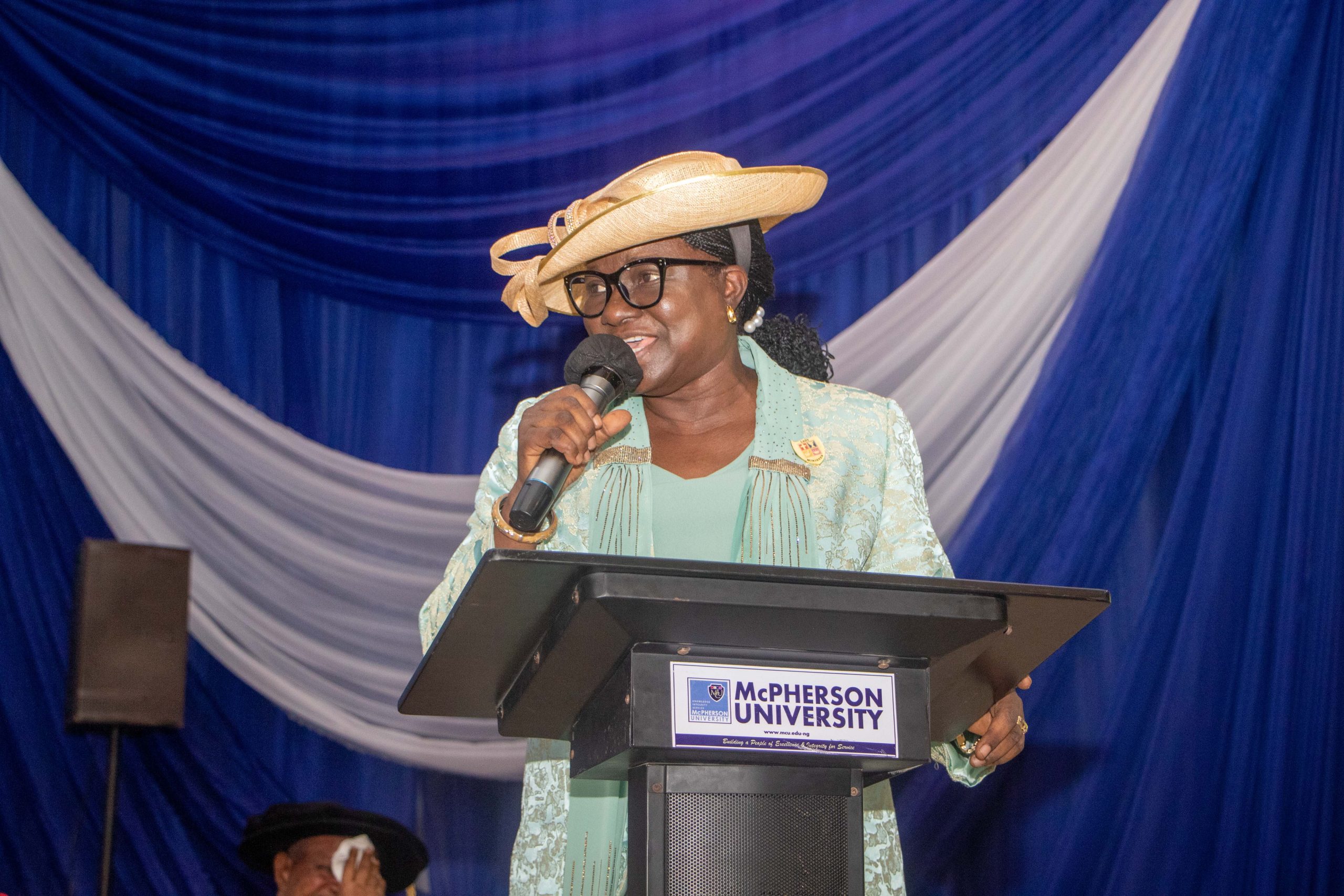










McPherson University, Seriki-Sotayo, Ogun State, has called for the integration of Artificial Intelligence (AI) into university administration to enhance efficiency, strengthen regulatory compliance and improve service delivery, while emphasising the need to preserve professional judgement, accountability and human values.
The call was made at the Second Annual Registry Lecture of the University, held on Thursday, November 19, 2026, as part of the maiden Registry Week, with the theme, “The Smart Registry: Leveraging AI for Efficiency, Compliance and Service Delivery.” The event brought together university administrators, registrars, scholars and other stakeholders from institutions across the country to examine the changing demands of university administration in the digital age.
Speaking at the event, the Vice-Chancellor, Professor Francis Adegbaye Igbasan, described the Smart Registry as an administrative system built around clear processes, reliable records, defined responsibilities and timely service. He maintained that technology should not merely be introduced for its own sake but deployed to improve the experiences of students, staff and other university stakeholders. He further cautioned that enthusiasm for Artificial Intelligence must not undermine professional judgement, confidentiality, fairness and accountability.
The Vice-Chancellor commended the Registrar, Mrs Emi’ Alawode, the planning committee and Registry staff for organising the lecture and the maiden Registry Week. He urged administrative professionals to remain committed to continuous learning and ensure that the knowledge acquired translates into improved institutional practices and service delivery.
The University’s pioneer Registrar, Mrs Adebola Abegunde, who served from 2012 to 2017, was also in attendance. She expressed delight at the University’s growth and achievements, encouraging and felicitating with members of the University community. In recognition of her contributions to the University’s foundation and development, she was presented with an award. The Vice-Chancellor, Professor Francis Adegbaye Igbasan, also received a Most Valuable Player (MVP) Award in recognition of his leadership and contributions to the University.
In her welcome address, the Registrar, Mrs Emi’ Alawode, disclosed that the University Registry had intensified its investment in staff development, revealing that 34 out of its approximately 50 members of staff had attended registry lectures in about ten universities across Nigeria within the year. She added that six more staff members were expected to participate in similar programmes before the end of the year, bringing the number of Registry personnel whose capacities had been strengthened to 40. She described the initiative as a deliberate investment in human capital and the development of a more efficient administrative system.
Mrs Alawode also highlighted several administrative reforms introduced under her leadership, including the adoption of exit forms for staff and students to promote accountability, proper handover, institutional record-keeping and the protection of university property. She further announced that, beginning with the February 2027 graduation, graduating students would receive supplementary certificates alongside their degree certificates and transcripts, documenting their holistic formation, skills and experiences acquired during their studies. Outlining the Registry’s next phase of development, she identified the expansion of digital records management, establishment of a proper staff onboarding system, development of the Academic Affairs and Alumni Directorate, and expansion of the University’s alumni database as key priorities.
Delivering the keynote address titled “From Files to AI: Lessons from Two Eras in University Administrations,” Dr Bola Adekola, former Registrar of the Federal University of Agriculture, Abeokuta, and pioneer Registrar of Fountain University, Osogbo, drew on his 35-year career in university administration to explain the transformation of Registry operations from manual processes to digital systems and emerging Artificial Intelligence applications. He identified the Registry as the memory, conscience, engine room and legal guardian of the university, stressing its responsibility for institutional records, governance, statutory compliance and administrative continuity. He explained that AI could significantly improve minute writing, document retrieval, meeting summaries, compliance checks and transcript processing, while warning that simply providing computers without redesigning administrative workflows would not produce meaningful transformation. He maintained that AI should complement rather than replace Registry professionals, noting that human verification must remain central to administrative decisions.
Also delivering a presentation, the Guest Speaker, Dr Grace Olubunmi Babalola, Registrar of Adekunle Ajasin University, Ondo State, spoke on “The Smart Registry: The Critical Nexus of Artificial Intelligence, Legal Intelligence and Emotional Capital.” She emphasised that an effective Registry must balance technological advancement with legal compliance and emotional intelligence. According to her, every application, complaint, file and transcript represents a person whose experience must be considered in the discharge of administrative responsibilities. She cautioned against allowing automated systems to make decisions without appropriate human intervention, stressing that technological capability does not confer legal authority. She further highlighted the importance of data protection, confidentiality, fairness, transparency and empathy, maintaining that the smartest Registry is not necessarily the one with the most technology but one that uses technology without losing its humanity.
The lecture also featured the introduction of the McU Social Impact Awards by the Registrar, an initiative designed to recognise individuals making meaningful contributions to the University community, particularly those whose efforts often go unnoticed. The recognition formed part of the University’s broader commitment to fostering appreciation, belonging and positive institutional relationships.
The event ended with renewed calls for continuous professional development, responsible technology adoption and a people-centred approach to university administration.